You did everything the experts told you to do. You created a beautiful free meditation, a downloadable breathwork guide, or a sample chapter of your book. You put it behind a simple signup form, promising that anyone who entered their email would receive it instantly. And it worked, sort of. The numbers climbed. Two hundred subscribers. Five hundred. A thousand. On paper, your community was growing.
Then you sent your first real newsletter, and almost no one opened it.
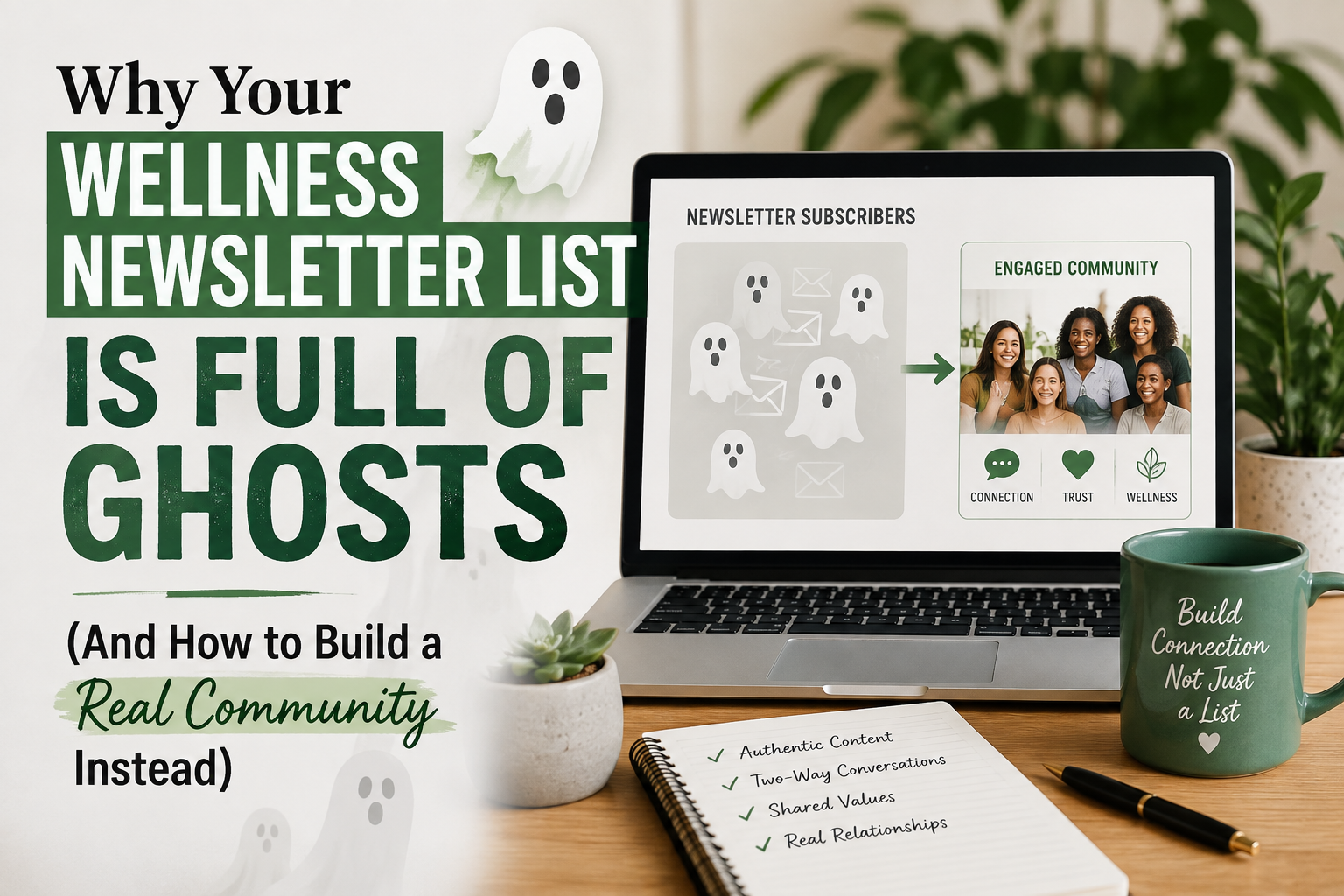
If you have felt that particular deflation, that gap between an impressive subscriber count and the silence that follows, you are experiencing one of the most common and least discussed problems in the wellness space. A large chunk of your list is not a community at all. It is a crowd of ghosts. And until you understand why they are there and how to build something real instead, you will keep pouring your energy into an audience that was never truly listening.
This is not a story about failure. It is a story about the difference between attention and connection, between a number that looks good and a relationship that actually matters. For teachers, coaches, and authors whose entire work is about depth and presence, this distinction is everything.
The Ghost Problem, Explained Gently
When you offer something valuable for free in exchange for an email address, you attract two very different kinds of people.
The first kind genuinely wants what you offer and is curious about you. They give you their real email, they read your welcome message, and they are open to hearing more. These are your people.
The second kind wants the free thing and nothing else. They have learned, quite reasonably, that handing over their real email to every website that asks for one leads to an inbox buried in follow-ups. So they protect themselves. They enter a throwaway address, grab the download, and vanish. The email they gave you was never meant to receive anything. It was a key to open a single door, and once through it, they let the key dissolve.
This second group is why your open rates look so grim. Those addresses were often temporary email addresses, designed to expire shortly after use. They inflate your subscriber count while contributing nothing to your actual reach. Every newsletter you send to them bounces or lands in a void, and worse, high bounce rates and low engagement quietly train email providers to treat your messages as low quality, which can hurt your ability to reach even the real people on your list.
It is worth sitting with the fact that these ghost subscribers are not villains. They are ordinary people protecting their peace, using the exact same instinct toward boundaries that you probably admire in other contexts. The problem is not that they are bad. The problem is that you built your entire measure of success around counting them.
Vanity Metrics Are a Trap for Sensitive People
There is a specific danger here for wellness practitioners, and it is worth naming directly. People drawn to this work are often thoughtful, intuitive, and a little sensitive to validation. A rising subscriber number can feel like proof that you matter, that your message is landing, that you are on the right path. And a stalling number can feel like personal rejection.
When you attach your sense of worth to a metric that is half illusion, you set yourself up for a painful cycle. You chase bigger numbers with flashier free offers, which attract even more freebie-seekers, which further dilutes your list, which makes your engagement rates look even worse, which makes you feel even more anxious. You end up building your emotional stability on a foundation of ghosts.
The way out is a quiet reframe. A list of one hundred people who genuinely want to hear from you is worth infinitely more than a list of five thousand who forgot they ever signed up. Depth over breadth. This is a principle you almost certainly already teach. It simply needs to be applied to how you build your audience, not just how you breathe.
Build the Front Door Before You Worry About the Crowd
Before you can attract the right community, people need to be able to find and remember you. This is where a surprising number of wellness brands undermine themselves at the very start, long before the email problem ever appears.
If your community, newsletter, or method has a forgettable or confusingly generic name, you make it harder for the right people to seek you out on purpose. The wellness world is saturated with soft, spiritual language, and a name built entirely from words like “calm,” “flow,” and “serenity” can blur into the thousands of others using the same vocabulary. When you want to build something people return to deliberately, a distinctive name is not a luxury. It is the difference between being sought out and being stumbled upon by accident.
If you are naming a newsletter, a community, a signature program, or a book, it helps to check how much competition your idea already has. Passing your favorite names through a similar name analysis tool shows you whether you are claiming fresh ground or crowding into a space already full of near-identical offerings. A name that is genuinely yours becomes an asset that compounds. Every mention, every recommendation, every search points cleanly back to you rather than getting lost among a dozen soundalikes.
And if the naming itself has you stuck, which is common, feeding your core themes into an AI-powered name generator is a fast way to move past the blank page. You are looking for something clear, speakable, and distinct enough that when someone hears it once, they can find you again. That findability is the quiet foundation everything else rests on.
Make It Easy for the Right People to Find You
Naming solves the problem of being remembered. Discoverability solves the problem of being found in the first place. If you are building a hub for your work, whether that is a resource library, a blog full of reflections, or a simple home for your book and offerings, you want search engines to understand and surface it.
This is not about gaming an algorithm. It is about clearing the path so that the person searching at midnight for exactly what you offer can actually arrive at your door. One of the most basic and neglected steps is making sure search engines have a complete map of your site. Generating and submitting a proper sitemap using a sitemap generator tells search engines precisely what pages exist and how they connect, which helps your genuine content reach the people looking for it.
When the right people find you through a deliberate search, something important happens. They arrive already interested. They are not freebie-hunters who bounced in from an ad; they are seekers who typed a real need into a search bar and found you waiting. These are exactly the subscribers who become a real community, because they came looking for depth in the first place.
Attract Fewer, Better People on Purpose
Once your foundation is solid, you can shift your entire approach to list-building from “get as many emails as possible” to “attract the right people and gently filter out the rest.” A few practices make an enormous difference.
Ask for a little more commitment. A signup that requires nothing but an email invites drive-by grabs. A signup that asks a simple question, or that clearly explains what someone is committing to receive, naturally filters for people who actually want the relationship. You are not adding friction for its own sake; you are inviting intention.
Offer a taste, not a treasure chest. When your free offer is so enormous that it is worth grabbing and ghosting, you attract ghosts. When your free offer is a genuine, useful taste that leaves people curious for more, you attract people who want to continue the journey with you. Quality of offer shapes quality of audience.
Send a real welcome. The first message someone receives sets the tone for everything. Instead of dumping the download and disappearing, use that first email to say hello as a human being, to share why you do this work, and to invite a reply. The subscribers who write back, even briefly, are announcing themselves as real. Pay attention to them.
Clean your list without fear. Every so often, it is healthy to remove the addresses that have never once opened a message. It feels counterintuitive to shrink your own numbers on purpose, but a smaller, engaged list reaches inboxes more reliably and reflects the truth of your community. Letting go of ghosts is its own kind of practice.
What Engagement Actually Looks Like in Wellness
It helps to redefine what a “good” email relationship even means in this particular field, because the standard marketing advice does not always translate. In many industries, engagement is measured in clicks, purchases, and conversions. Someone opens an email, clicks a link, buys a product, and the loop is considered complete. Wellness rarely works that way, and forcing it into that mold makes both you and your readers miserable.
Your community may open your message, sit with a single line of it, feel something shift, and never click anything at all. That is not disengagement. That is exactly the kind of quiet, internal response your work is designed to produce. A reflection that helps someone breathe more slowly on a hard morning has done its job completely, even though it will never show up as a conversion in any analytics dashboard.
This means you have to hold two truths at once. On the technical side, you still want real, deliverable addresses and healthy open rates, because those keep you reaching inboxes at all. On the human side, you should resist judging every email by whether it produced an immediate action. Some of your most devoted readers are the quietest ones. They are absorbing, practicing, and slowly becoming the people who buy your book the day it launches and tell three friends about it, precisely because you never pressured them for a click.
Watch for the softer signals. The occasional heartfelt reply. The person who mentions in a session that your last note arrived at the perfect moment. The reader who has been silently present for a year and then suddenly shows up to everything you release. These are the fruits of real community, and none of them appear in a subscriber count. Learning to trust them is part of building a practice, and an audience, that can actually last.
Community Is Built on Being Known, Not Counted
Underneath all the tactics lives a simple truth that should feel deeply familiar to anyone in this field. Real connection cannot be manufactured through volume. It grows through being genuinely known by a smaller number of people who chose you on purpose.
The wellness teachers who build lasting, sustainable work are almost never the ones with the biggest lists. They are the ones whose smaller communities feel personally seen. Their newsletters get opened because the people on the other end actually want to hear from them. Their book launches succeed because a few hundred true believers show up, rather than a few thousand strangers ignoring the announcement.
So if your list is full of ghosts, do not despair, and do not chase bigger numbers to cover the disappointment. Turn instead toward the real people already there. Write to them as individuals. Make it easy for the right seekers to find you and remember your name. Offer genuine value that invites commitment rather than a quick grab. And measure your success not by how many addresses you have collected, but by how many humans actually feel met by your work.
A crowd of ghosts can never sustain you. A small circle of people who genuinely want what you offer can sustain a lifetime of work. Build for the circle. That is where the real community, and the real fulfillment, has been waiting all along.